- Hanging clothes outside on a beautiful, sunny day is like meditation. It calms me down. It makes me slow down because it is something that can't be hurried. It allows me to soak up some Vitamin D while getting a chore done... and both things serve to make me happier.
- A laundry line of clothes gently blowing in the breeze on a sunny day is one of those picture perfect things. Seeing a laundry line always makes me stop and appreciate the simple, utilitarian beauty of it.
- Drying clothes on a rack inside in the winter helps raise the humidity in our dry, Wisconsin homes. This was brought to my attention by my Weather & Climate professor in college. An indoor clothes rack or line is like a free humidifier. Why whisk that free winter moisture out through a dryer vent?
- Clothes last longer when they are line-dried. This is obvious when you think of all the tumbling and rocking and rubbing that clothes do in a dryer.
- Clothes don't shrink when they are line-dried. This is typically a good thing, but my sister, a recent clothesline convert realized that she had actually been banking on the shrinking to help clothes fit her kids. Now she has to re-think sizes. I think this is an isolated problem with a solution.
- It saves money. According to laundrylist.org it can save households over $100 in electricity in a year. One hundred dollars a year. That amazes me. Of course, that number may be for households in sunnier climes than Wisconsin, but still.
- Perfectly crisp cloth napkins, no iron required.
- It is just one more little thing you can do that can help slow global warming. I personally find the little things to be hugely empowering.
- It makes me feel proud that I live in a neighborhood that hasn't banned clotheslines (many newer subdivisions across the U.S. have for aesthetic reasons). And when I can see 4 clotheslines on my block just from the vantage point of my front yard it makes me even prouder.
- It makes me feel retro, cool, and eco-saintly. All from one chore!
Thursday, May 29, 2008
Top 10 reasons to hang out
I've been feeling very list-y lately, making lists left and right, so it seems appropriate to include a list on the blog. So today I present you with my top 10 reasons to line dry your clothes, inside or outside, January or July.

Wednesday, May 28, 2008
Martha Stewart Drying Rack
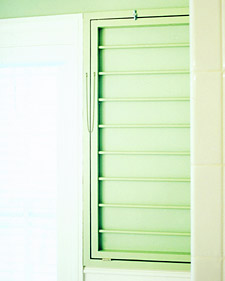
As an answer to Kris' query below, I think that the Martha Stewart Foldout Drying Rack above is just about the super coolest indoor drying rack possible. It folds down to hang clothes on and then folds flat against the wall when you don't need it. I think it looks like art in its folded-up state. You can find directions on how to make it here on Martha's website. Because I know Kris' husband has, like, a ton of time to tackle a new project :)
Of course, knowing the layout of Kris' super sweet laundry room (I am a bit jealous of it, actually), an indoor, retractable line stretching across the room might work best.
Friday, May 23, 2008
indoor laundry line
One of my goals for this month was to rig up an indoor line or two for winter hanging. This wouldn't be for all the clothes as I don't have a big area, but could be for my daughter's pants that I don't want to shrink faster than she is growing, maybe a sweater drying rack etc. I have a "laundry closet" that is long and narrow-just the depth for the washer and dryer and twice as long.
I am looking for suggestions on what might work or design ideas from other people that might be more fun and useful that just stringing up a line (although that is an option). I am thinking there may be ways to do a pull out drying rack or that kind of thing that maximizes space. If you have something that works, especially for small spaces, I'd love to hear about it! Once my tomato plants are off the shelf, I'll be ready for the next project.
Tuesday, May 20, 2008
Soil Test Results
The mail arrived on Saturday and I opened the envelope from the UW Soil and Plant Analysis Lab with some trepidation. Would my soil be found worthy or would I be found out as a slacker home owner who has neglected to apply the required fertilizer and be kicked out of the suburbs? I chuckled a bit with how similar this felt to the time I had my breastmilk analyzed in the hospital lab to ensure it had adequate fat content for my 2 pound preemie ( I, or it, passed).
I am happy to report that I have a high, off the charts, amount of phosphorus (for root and bud growth) and Potassium (for disease and drought resistance). I think phosphorus is high in WI in general which begs the question of why it is in fertilizers around here. The pH was on the high end of optimum (7.5) which at first I thought was good and the lab even reported that no adjustment is necessary. However, I have since read the dandylions love this pH and I'd be wise to reduce it a bit with some sulfur.
Nitrogen levels were not measured and this bummed me out because I figured I'd score big on this one too. I figured all that all that mulch mowing, my three backyard pooping chickens and nitrogen-fixing clover everywhere should count for something. However, adding nitrogen was the only recommendation they gave me (for green and leaf growth). Turns out that grass is a big fat nitrogen hog and wants me to give it more and more. They tell me I can skip the Sept application if we mulch mow. Time to look into some organic fertilizers with ingredients such as dehydrated manure, fish emulsion, and blood and bone meal (yikes!). Since so much of my lawn is shady, it looks like I can use less of the stuff. Speaking of chicken poop-I did check it out and it is a good nitrogen source and you can by it by the gallon for 16 bucks. I'll sell you a gallon for half of that!
Leaving on the grass clippings did give me a proud 3.9% organic matter in my soil. Seems all the good soil microbes like it between 2-5%. Maybe a bit of compost top dressing and I can score a 5 by next year. I would have liked to know more about my soil's ecosystem. What critters are working for me out my backdoor. Sounds like a good summer project for my 11 year old and her microscope.
So I am happy with my report card but still not happy with the ever expanding mass of thistle, creeping charlie and crabgrass across my property. The whole topic is overwhelming but I continue to learn and this past months blog topic has kept my husband from buying the weed and feed for another season while we get it all figured out. Still looking for that natural lawn service.
Homemade Detergent Lab Trials, Part 2
As promised, here are the results to my detergent trials, presented in classic lab report style for easy comprehension and grading. I think I deserve at least a 7 out of 10, if not an 8 out of 10 for neatness.
Homemade Laundry Detergent Lab
Chem Study/Mr. Busse/Hour 7
Hypothesis: The homemade laundry detergent will work as well as Mrs. Meyers laundry detergent, but it will not smell as good. (As an aside, what was the point of writing hypotheses? Do kids these days even have to write them?)
Purpose: To test the efficacy (love using that word ever since seeing the movie "Side Effects" with Katherine Heigl.... I realize I am mis-using the word here) of homemade laundry detergent in comparison to the always perfect Mrs. Meyers Clean Day laundry detergent.
Materials:
1 bar Fels Naptha soap, grated
1 cup Washing Soda
1 cup Borax
4 loads of dirty clothes
3 loads of sheets and blankets
1 front loading HE washing machine
1 clothesline
1 blustery, partly sunny day
Procedure:
1. Make homemade laundry detergent according to this recipe, but omit the Oxy Clean (for no other reason than I am cheap and I remember a very annoying Oxy-Clean ad from the past and therefore refuse to buy it).
2. Do laundry, lots of laundry under usual conditions. "Normal/Casual" cycle. Warm/Cold temp. Vinegar rinse. Clothesline dry.
3. Take care to note differences in outcomes. Smell, feel, stain removal, etc.
4. Fold and put away laundry.
Conclusion:
Well, I gotta say, I can't tell the difference between loads I did with the homemade and the loads I did with the Mrs. Meyers. Both detergents got out all the obvious stains. Neither detergent got out stains that had always existed. After line-drying all loads smelled the same, that sort of line-dried sort of smell (which some people love, but I can go either way dependent upon whether it was a sunny day or a cloudy day). My icky, back of the throat feeling I got from grating the Fels didn't exist after the clothes came out of the washer, in fact they smelled pretty good, like good and clean. One thing I did notice was that the clothes that were washed with the homemade detergent felt softer, but this is hard to quantify and may just have been because I was using a cordless drill right before folding the clothes and therefore had a bit of that numb finger thing going on that makes everything feel softer. Because of the fact that making homemade detergent is super cheap (Modern Cottage has figured it out to be about 5.7 cents a load, whereas Mrs. Meyers, as much as I love her, is about 40 cents a load) I think I will continue to make my own, but use Dr. Brommer's soap in place of the Fels Naptha to avoid the issues I had yesterday. Though I did just visit the Mrs. Meyer's site and got sucked in by all the pretty things and packaging and the fact that they have a new line of baby-friendly products. Swoon.
Monday, May 19, 2008
Homemade Detergent Lab Trials, part 1

I finally tracked down some Fels Naptha soap at Sentry in Delafield (thanks to the anonymous commenter who mentioned she found it at the Sentry in Waukesha) and was all hopped up and excited to make my homemade detergent. The euphoria didn't last long as while I was grating the soap according to these directions at Modern Cottage I started to get that feeling in the back of my throat. Do you know that feeling? That sorta coughy, sorta icky feeling that lets you know that something is perhaps a bit toxic? Well, I was getting that vibe, a strong vibe, from the Fels Naptha. I grated away and mixed up the potion (Fels, washing soda and borax) anyway and am currently running some lab trials (more on that in a second). However, the vibe was strong enough that I sat down and did some Google investigating and it seems that the verdict is unclear, some people say that Fels is safe for the environment, others say it isn't natural and is bad because it contains petrochemicals. The ingredient list is bizarre: "cleaners, soil & stain removers, chelating agents, colorants, perfume". Seriously? Can a product really get away with being this vague? So, I'm not sold on the whole Fels Naptha thing. If this recipe for homemade detergent works well and I decide to make it again I will substitute Dr. Brommers castille soap for the Fels. Wish I would have thought of that earlier as I could have gotten that by walking a block to Hartland Market!
Anyway, the lab trials are underway. Due to a rather messy and dirty week we have much more laundry than usual, which makes for great experiment conditions. I have two loads of whites and two loads of darks, one of each I will use my ever-faithful, ever-perfect Mrs. Meyers Clean Day laundry detergent in Geranium (which smells like heaven). For the other two loads I will use the new homemade laundry detergent (pictured above, on the right). All other variables in the trials will be kept consistent: water temp, spin speed, clothesline dry. All I need is my lab notebook and it will feel just like a high school lab experiment. Materials, Hypothesis, Procedure, and Conclusion. My lab report will be completed by tomorrow. Please check back for the amazing conclusion. I know you are all on the edge of your seats :)
My laundry day has been made a bit more complicated today, not because of the lab trials, but because of this adorable rabbit who has decided to burrow in to our bed of spiderwort and have her babies right outside our back door. So, I have to be extra quiet and respectful as I head out to hang laundry. No screen door slamming and all that. I think this rabbit is the cutest thing ever, and I said so to my husband. He corrected me and said that, no, the cutest thing ever will be when the baby rabbits appear. I think he is right on this point.

Saturday, May 17, 2008
the good and bad on OxiClean
I have never been all that good at getting clothes clean. I am good with the general dirt and stink, but stains have always resisted my efforts. I realized at one point that the problem might have been in my "collective" approach to laundry. I do sort by color, but after that I push a button and expect the machine to do the job to the load. I don't read the labels much and sort of figure that the socks, shirts and pants are all "in it together".
Unfortunately, I have learned that getting clothes clean requires individualized attention. I asked a friend (whose lack of stains on her children I admired) what she does and she said that every night she collects the clothes from her four children and inspects for stains. All stained clothes get a treatment of OxiClean for the night and then get washed later. I finally decided to try a stain remover and this approach thinking that using a chemical might be justifiable over throwing out perfectly good but stained clothes. It was magic! I think the biggest factor is simply soaking it right away, but the stuff worked great.
Since then I have been using OxiClean guiltily thinking it was probably nasty for the environment but possibly justifiable until I got around to a more Green alternative. I told myself that it was certainly better than using bleach. Writing this blog got me looking into the ingredients in my beloved stain remover.
The Good News: OxiClean is described by some as an "environmentally friendly, natural" product. I was thrilled to find that OxiClean contains two active ingredients: Sodium Percarbonate and Sodium Carbonate. The first is baking soda and the second is washing soda. This stuff is just what my grandma used! These substances form oxygen, hydrogen peroxide and soda ash when mixed with water. The oxygen is what cleans and brightens. There are no phosphates or bleach, which are two of the worst environmental offenders in most laundry products.
The Bad News: What is not clear is what other fragrances or other ingredients might also be in there, but I am assuming there is something as it smells like more than baking soda and works better too. The container doesn't say what else is in there so that is a bit concerning. They do sell a "free" product without the dyes and fragrances, so by default it must be in the original. There is also a newer version apparently with "little blue crystals". No idea what that is but it sends off some warning lights to me. It is also not clear if the product also contains surfactants, which have a negative environmental impact. The fact that I can't get an accurate ingredient list makes me more concerned than anything. Also it is sold in a plastic container that is not recyclable.
I am certainly no expert on this and my research involves a brief before-breakfast search so I'd love to hear from others if you know differently or if you know of a more green product that works well and especially where to buy it locally. Looks like lots of other green household products contain the two active soda ingredients. Do they work as well without the "mystery ingredients?
Subscribe to:
Posts (Atom)